After spending our first night in a cheap hotel in Miami Beach, we headed to Little Haiti as quickly as possible. A neighbourhood where English is by no means the most widely spoken language. Small, colourful houses with large gardens stand next to undeveloped plots of land where chickens roam freely and occasionally stray onto the street, forming a sharp contrast to the commercial giants found in Miami Beach.
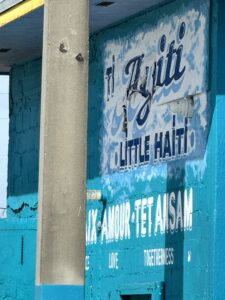
Many Haitians live here in exile, and with the situation in their own country becoming increasingly complicated, the flow of people leaving Haiti is not likely to stop anytime soon. In search of a dignified life, they leave their homes in the centre of the country in Port-au-Prince and the surrounding regions with a heavy heart.
Heavily laden, we wandered more or less by instinct to make contact with local people. This is how we came across the Little Haiti Cultural Complex, after two friendly Canadian restaurant owners informed us that 11 November is Veterans Day and that opening hours would not be as usual on that day.
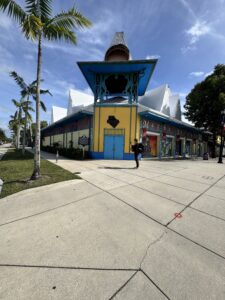
At first glance, the centre looked pretty locked up. The shutters were down and nicely decorated. We knocked on the relatively dark shop window of “Libreri Mapou“. Jan Mapou is the owner and founder of the bookshop, which specialises in books about Haiti in Creole, French and, thankfully, some English translations. It is a real treasure trove for anyone who wants to learn about the history of Haiti first-hand.
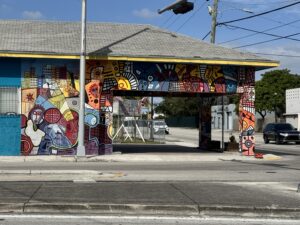
The door was opened and we were warmly welcomed, especially after we explained what we were about to do. That’s how we met Dubionel St. and Jan Mapou. We told them about our plans to travel to Haiti, whereupon the two elder gentlemen spontaneously told us how dangerous it is there and then asked if we had any contacts there, because without them they would advise us to stay away.
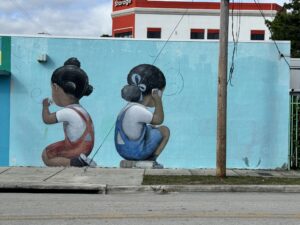
We eagerly engaged in conversation and had two very well-informed Haitians in front of us to whom we could address some initial questions. It turned out that Dubi (Dubionel) is also a police officer in Miami. We learned about the challenges the people of Little Haiti are facing. There, too, the situation is steadily deteriorating. There are too few jobs, and increasing gentrification is making life more expensive in Little Haiti as well.
Mapou has rare books by Haitian authors, scientists and freedom fighters in his “libreri”. He knows and guards this treasure well.
Paul whom I have come to appreciate very much since I suggested to him in August – on the first day I met him – that we travel to Haiti together. He is my companion on this Haiti adventure, so you’re gonna hear about him sometimes. We equipped ourselves with some of the rare books in English and after half an hour of lively conversation, we arranged to meet Dubi again at Mapou’s for an interview the next day and looked for a hostel nearby.
As we said goodbye, Dubi warned us not to underestimate Mapou, as he is an influential man. 😉